Database Setup Strategy in Specify
Introduction
UniMus:Natur must decide how to structure our databases in Specify. Options range from a single database for all museums and collections to one database per collection at every museum. This setup impacts data standardization, backup regimes, and user roles.
See also: Risk Assessment for a detailed breakdown of risks associated with these options.
Specify Hierarchy
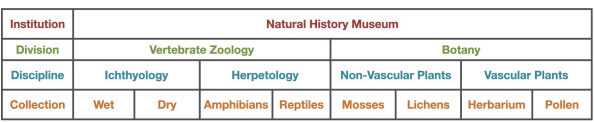
Each database (termed an “Institution” in Specify) can be divided into:
- Divisions
- Disciplines
- Collections
Initially, the decision focuses on the number of databases/institutions. Decisions regarding lower-level subdivisions will be made subsequently.
Data Scope
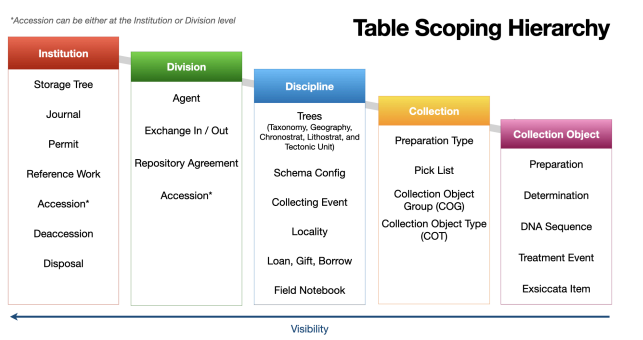
The setup determines which data tables are shared. Some data is shared between Collections, others between Disciplines, and some between Divisions. However, to share data (e.g., in a Person module), the entities must reside in the same database (Institution). No data is mechanically shared between separate databases.
Considerations
Pros and Cons of Sharing
According to Specify:
- Data Sharing: reduces entry errors and standardizes data. However, errors are propagated to all collections, and user permissions can become complex.
- Backup and Restore: A major disadvantage of a shared database is the “all or nothing” restore. If one collection needs a rollback, the entire database (and all other collections) must be rolled back.
- Standardization: Easier to implement standards (e.g., SQL updates) across multiple collections in a single database.
- Risk: Modifications intended for one collection might accidentally affect others.
Options for UniMus:Natur
- One database for all museums and all collections.
- One database per museum (5 databases), further divided into Divisions, etc.
- One database per main organism group (e.g., Botany, Entomology, Zoology, Geology) across all museums (4 databases).
- One database per main organism group per museum (20 databases).
- One database per collection at each museum (~60 databases).
Trade-offs
Low Fragmentation (Few Databases):
- Pros: Benefits from data standardization; quality improvements benefit everyone. Shared resources (like Person IDs) are available to all.
- Cons: harder to administer, potentially large technical size affecting performance, errors affect everyone. Less flexibility for UI customization per museum. Storage trees and permissions are shared.
High Fragmentation (Many Databases):
- Pros: Greater control over own data and UI, easier administration per unit.
- Cons: Hard to link objects between collections (e.g., Tissue sample in one DB, Voucher in another). Queries cannot be shared. Users needing access to multiple collections need multiple logins/accounts.
- Mitigation: Some issues can be mitigated by developing external tools (e.g., using APIs to sync Person modules).
Case Studies
- Denmark: Uses Specify at 8 natural history museums with one database per institution.
- University of Kansas: Decided on separate databases for each collection 20 years ago. They now regret this; fears of over-sharing were unfounded, and rollback needs have been minimal (approx. twice in 20 years).
- Royal Botanical Garden Edinburgh: Went to the other extreme, merging all physical collections (vascular plants, mosses, lichens, fungi) into a single Collection within Specify.